
The traditional security perimeter has dissolved. As corporate networks expand across cloud environments, distributed workforces, and interconnected APIs, the longstanding reliance on knowledge-based authentication has reached an untenable dead end. Passwords, PINs, and security questions are fundamentally flawed because they rely on shared secrets that can be intercepted, guessed, phished, or purchased on dark web forums. Even conventional multi-factor authentication, such as SMS verification codes, regularly succumbs to SIM-swapping schemes and automated adversary-in-the-middle attacks.
Biometrics rewrites this equation by replacing shared knowledge with intrinsic human identity. Rather than asking an employee or customer to remember an arbitrary string of characters, modern systems evaluate unique physical and behavioral markers. Yet integrating biological markers into digital security requires far more sophistication than simply replacing a login prompt with a camera sensor. Real security demands an architecture capable of confirming identity instantly, preserving individual privacy, and withstanding determined spoofing attempts.
The Architectural Evolution of Digital Biometrics
Early consumer biometric implementations functioned primarily as local conveniences, matching a stored picture of a fingerprint or face against a fresh scan. In high-assurance enterprise environments, that model has evolved into a cryptographically anchored verification pipeline.
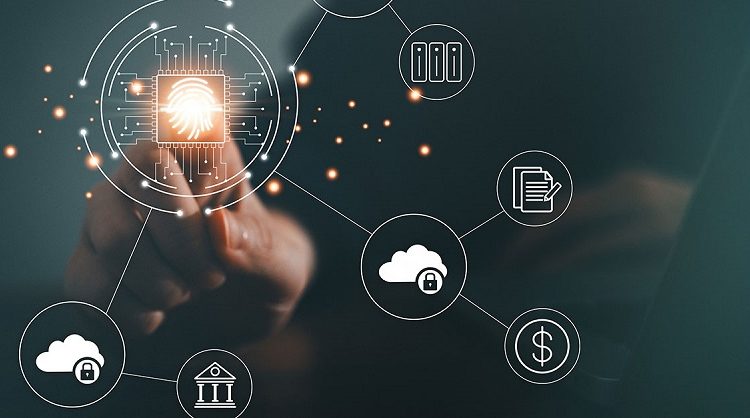
Modern biometric architectures rarely transmit, compare, or store raw biological imagery. When an individual registers their identity, specialized sensors capture precise physical measurements and convert them into an encrypted mathematical template. Under standards like FIDO2 and WebAuthn, this template resides within a hardware-isolated environment, such as a Secure Enclave or a dedicated Trusted Platform Module (TPM).
During an authentication challenge, the biometric sensor verifies the user locally against that isolated template. Once confirmed, the secure processor uses an asymmetric private key to cryptographically sign the assertion sent to the server. The external network never sees the biological data; it receives only proof that the legitimate user has successfully validated their identity on their trusted device. This decentralization fundamentally changes threat modeling, as an enterprise database breach cannot compromise the physical identities of millions of users.
Primary Physical Modalities Powering Enterprise Access
Organizations deploy different physical biometric modalities depending on security thresholds, ambient hardware capabilities, and user friction tolerances.
Facial Geometry and Advanced Liveness Verification
Facial recognition has become ubiquitous, but its enterprise utility hinges almost entirely on presentation attack detection (PAD). Standard two-dimensional optical cameras remain vulnerable to high-resolution printouts, digital playback on mobile screens, and silicone masks.
High-assurance deployments rely on three-dimensional structured light sensors or time-of-flight depth mapping alongside infrared imaging. These systems cast thousands of invisible infrared dots across the user’s face to measure precise surface topography, bone structure, and skin reflectance. Simultaneously, deep learning models analyze subtle physiological indicators—such as micro-expressions, pupillary responses, and minor vascular pulse signatures—to guarantee liveness. This multi-layered evaluation neutralizes synthetic media and real-time deepfake injections before access is granted.
Subdermal Vascular and Palm Vein Recognition
While optical and capacitive fingerprint readers remain standard for mobile endpoints, vascular pattern recognition represents a higher plateau of physical assurance. By projecting near-infrared light through the palm or fingers, sensors capture the unique layout of deoxygenated hemoglobin flowing through the user’s veins.
Because vascular networks exist beneath the skin surface, they are virtually impossible to replicate or capture without active cooperation. They leave no latent prints on public surfaces, remain unaffected by superficial skin abrasions or moisture, and function only when blood is actively circulating. Financial institutions and critical infrastructure facilities increasingly prefer palm vein authentication for high-value authorization gates where traditional fingerprint scanners carry unacceptable spoofing liabilities.
Voice Architecture in Remote Telephony
Voice biometrics analyzes over a hundred physical and behavioral vocal characteristics, including nasal resonance, vocal tract shape, speaking cadence, and harmonic frequencies. In remote customer support environments and automated telephony, voice verification allows organizations to authenticate callers passively in the background of a conversation.
The primary hurdle in voice systems is the rapid democratization of generative audio cloning. To maintain integrity, secure voice platforms pair spectral voice analysis with randomized liveness challenges, requiring users to repeat dynamic phrases while tracking real-time cadence and breath pauses to differentiate an authentic human speaker from an AI-generated voice stream.
Continuous Authentication Through Behavioral Biometrics
Static authentication verifies identity at a single moment in time, creating a blind spot: once a user logs in, the session remains open regardless of who sits behind the keyboard. If an attacker hijacks an active session or steals an unlocked laptop, perimeter defense fails.
Behavioral biometrics transforms authentication from an isolated gate into an ambient, continuous evaluation. Instead of measuring what a user looks like, behavioral models evaluate how a user naturally interacts with their hardware:
-
Keystroke dynamics: Measuring the millisecond flight time between specific key sequences, dwell time on individual keys, and pressure patterns.
-
Navigation ergonomics: Analyzing mouse acceleration, curvature of cursor pathways, and hesitation points before clicks.
-
Touchscreen mechanics: Gauging thumb sweep radiuses, contact surface area, and device tilt via internal accelerometers and gyroscopes.
These invisible signals build a continuous confidence score. If an authenticated user suddenly switches from typing with a familiar rhythm to pasting text rapidly while exhibiting altered cursor trajectories, the system recognizes the anomaly. It can dynamically restrict administrative permissions, lock the session, or trigger an immediate step-up biometric prompt before sensitive data can be exfiltrated.
The Irrevocability Problem and Data Sovereignty
Despite its strengths, biometric security introduces a unique vulnerability: physical identity cannot be reset. When a password leaks, the user issues a reset request. If a person’s raw facial geometry or iris mapping is extracted from an insecure database, that compromise is permanent.
This reality has catalyzed stringent regulatory frameworks, including the Illinois Biometric Information Privacy Act (BIPA) and Article 9 of the European Union’s General Data Protection Regulation (GDPR). Both frameworks treat biometric records as sensitive personal data requiring explicit consent, strict retention limitations, and robust storage safeguards.
To navigate this challenge, cryptographic engineers utilize cancelable biometrics and fuzzy extractors. These mathematical techniques intentionally distort raw biological markers using irreversible algorithmic transformations before storage. If an enterprise database holding transformed templates is breached, administrators simply rotate the transformation key. The original biological trait remains uncompromised, and the old transformed template becomes useless to intruders.
Calibrating Precision, Friction, and Enterprise Risk
Deploying biometrics successfully requires careful operational calibration. Security teams must continuously balance the False Acceptance Rate (FAR)—the likelihood that an unauthorized imposter is verified—against the False Rejection Rate (FRR), which measures how often an authorized user is mistakenly locked out. Setting thresholds too high breeds user frustration and prompts workers to bypass security protocols, while lax configurations invite compromise.
The modern consensus favors risk-based, multimodal architectures. Routine activities like checking internal email require only a frictionless local facial scan. High-risk actions—such as modifying production server configurations or approving six-figure corporate disbursements—automatically trigger step-up challenges combining physical vascular verification, contextual device signals, and behavioral checks.
By binding digital credentials directly to biological reality while preserving local privacy boundaries, modern biometrics delivers what passwords never could: robust, uncompromising security that operates seamlessly alongside human workflow.